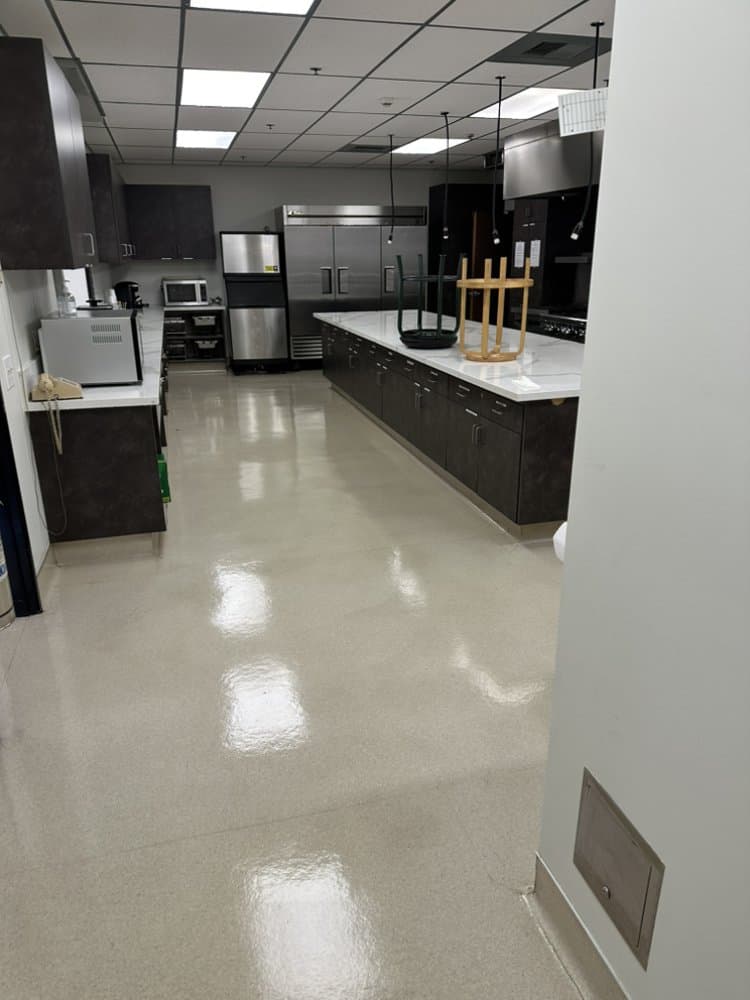
Most commercial VCT (vinyl composition tile) floors need a full strip and wax once or twice a year, with a scrub and recoat every 2 to 4 months in between and regular burnishing to hold the shine. Heavy-traffic areas like entrances, break rooms and main corridors usually run on the shorter end of that range.
The exact schedule depends less on the calendar than on how much traffic and grit the floor takes, and how well it's maintained between visits.
What sets the schedule?
Four things decide how long a finish lasts:
- Foot traffic. A lobby that sees hundreds of people a day wears through finish far faster than a back office.
- Grit tracked in from outside. Sand and dirt act like sandpaper on the finish. Good entrance mats can stretch a strip cycle noticeably.
- Daily upkeep. Dust mopping and damp mopping (or autoscrubbing) every day keeps abrasive soil off the surface.
- Burnishing. A high-speed burnisher brings worn finish back to a gloss and delays the next recoat.
A floor that's swept and burnished regularly can often go a full year between strips. One that only gets a wet mop may need stripping twice as often.
Strip and wax vs. scrub and recoat: what's the difference?
A strip and wax removes every layer of old finish down to the bare tile, then lays down fresh coats. It's the full reset. ("Wax" is shop talk: modern commercial floors are coated with acrylic polymer floor finish, not actual wax, but the name stuck.)
A scrub and recoat deep-scrubs only the top layer of finish and adds a few new coats on top. It's faster, less disruptive and cheaper, but it can only work on a finish that's still in decent shape. Each recoat adds a little buildup, which is why a full strip still has to happen eventually.
What does a typical VCT maintenance schedule look like?
| Task | Typical frequency | What it does |
|---|---|---|
| Dust mop, damp mop or autoscrub | Daily or nightly | Keeps grit off the finish |
| Burnish | Weekly to daily, by traffic | Restores gloss to worn finish |
| Scrub and recoat | Every 2 to 4 months | Refreshes the top layers |
| Full strip and wax | 1 to 2 times a year | Removes all old finish and starts over |
Ranges are typical, not fixed. A clinic hallway and a warehouse break room will land in different places on that table.
How long does a strip and wax take?
The area has to be closed while the work happens, so it's usually done overnight or over a weekend. A standard job goes like this:
- Clear the room and dust mop.
- Apply stripper and let it dwell for the time on the label, often 10 to 15 minutes.
- Scrub with a low-speed machine and stripping pad, then scrape the edges by hand.
- Pick up the slurry with a wet vac and rinse twice to neutralize the floor.
- Let it dry completely.
- Lay down 3 to 5 thin coats of finish, letting each one dry first (typically 30 to 60 minutes per coat).
Light foot traffic is usually fine about an hour after the last coat. Furniture and heavy carts should wait 24 hours, and most finishes take 2 to 7 days to fully cure.
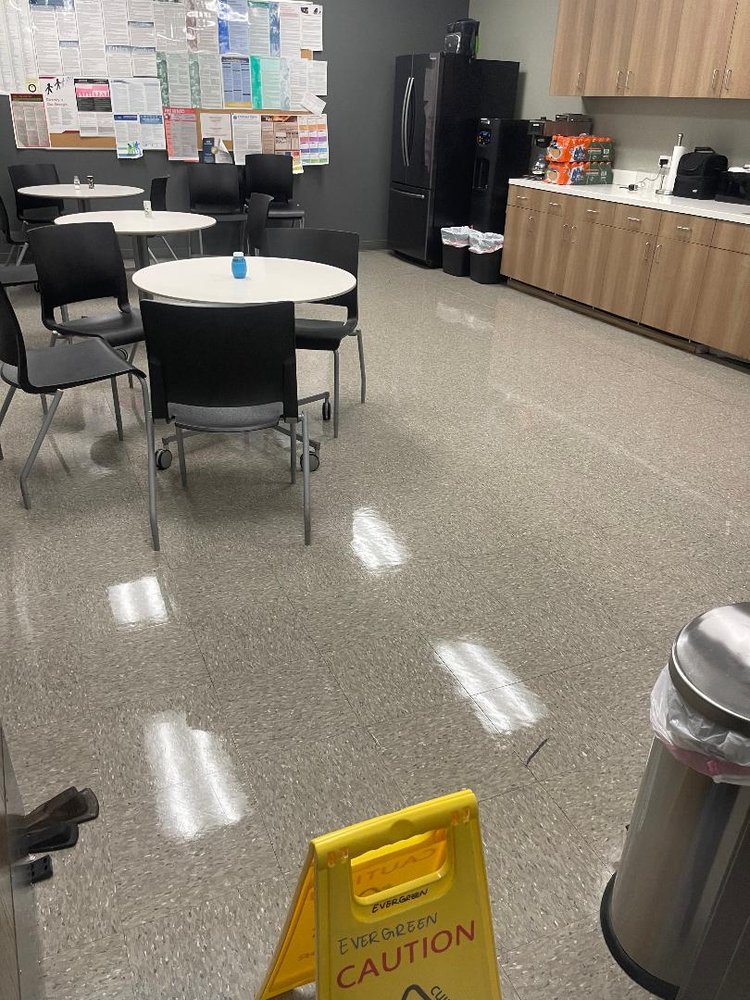
Signs your floor is due
- It stays dull even right after burnishing.
- The traffic lanes look worn through while the edges still shine.
- The finish has turned yellow, cloudy or patchy.
- Black marks and scuffs won't come up with normal cleaning.
- Dirt looks sealed into the finish rather than sitting on top of it.
Why a fresh finish fails early
Two mistakes cause most early failures. The first is skipping the rinse: stripper residue left on the tile keeps the new finish from bonding, so it peels or powders. The second is laying coats too thick: heavy coats dry soft and cloudy and scuff easily. Recoating over dirt is a close third.
What affects the cost of stripping and waxing?
Commercial floor waxing is priced by the job, and a few things move the number most:
- Square footage. Bigger floors cost more in total but usually less per square foot.
- Condition. Years of buildup take more stripper, more passes and more time than a floor stripped last year.
- Number of coats. New or badly worn tile needs more coats of finish.
- Furniture and access. Rooms that have to be emptied and reset take longer than open corridors.
- Timing. Scheduling the work overnight or on a weekend, so the space stays open during business hours, can affect the price.
Getting VCT stripped and waxed in DFW
We strip and refinish VCT and other resilient floors for offices, clinics, schools, break rooms and storerooms across Dallas–Fort Worth. Both photos on this page are from our own strip-and-wax jobs. Every job starts with a free on-site walkthrough, because the price depends on square footage, the floor's condition, how many coats it needs, how much furniture has to move and when the work can happen.
See our commercial floor cleaning services in Dallas–Fort Worth for the full scope, or set up the floor care that keeps the shine between strips as part of recurring janitorial service.