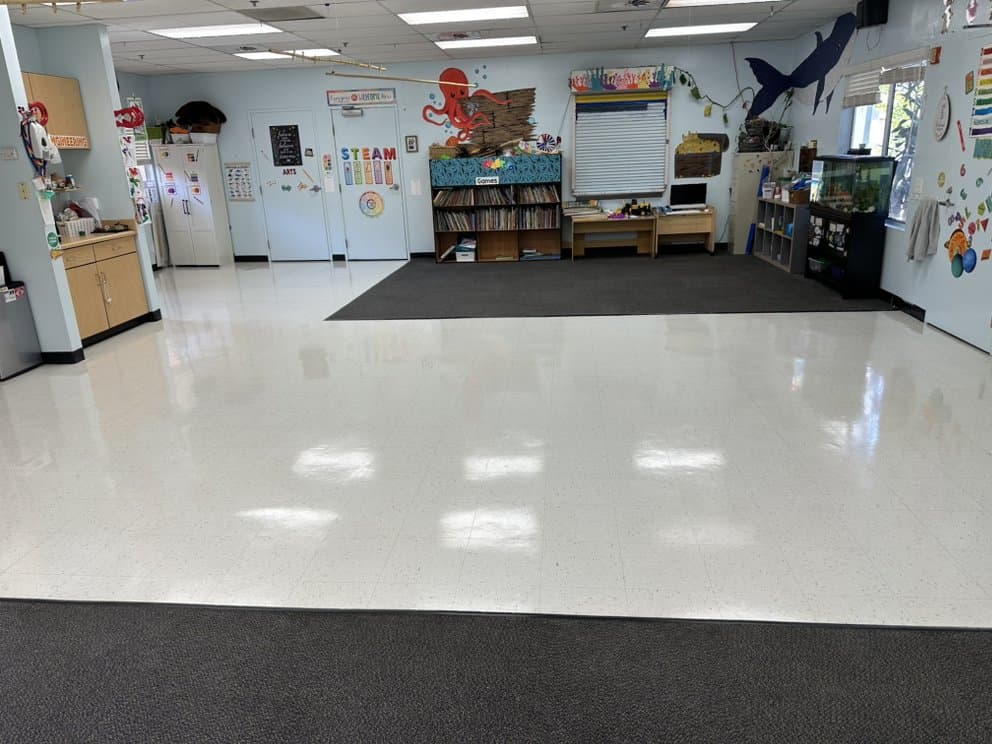
Buffing uses a slow machine and a pad to clean or lightly refresh a floor's surface, while burnishing uses a much faster machine to heat and harden the finish into a gloss. Burnishing only works on a clean floor with a cured finish, such as VCT (vinyl composition tile), which is why scrubbing usually comes first.
Texas Industrial Cleaning Services is a commercial cleaning company serving the Dallas–Fort Worth Metroplex. We provide office cleaning, commercial floor cleaning (including stripping and waxing), and recurring janitorial services for offices, medical and dental practices, and multi-tenant buildings across Dallas, Tarrant, Denton and Collin counties.
What is the difference between buffing, burnishing, polishing and scrubbing?
Buffing is slow pad work, burnishing is high-speed gloss work on a cured finish, polishing is a loose word that can mean either, and scrubbing is machine cleaning that lifts soil off the floor. Each does a different job.
| Job | Machine and speed | What it does | Floor types |
|---|---|---|---|
| Buffing | Slow floor machine, 150 to 330 rpm (revolutions per minute) | Cleans or lightly refreshes the finish with a pad | Finished hard floors |
| Burnishing | High-speed burnisher, 1,000 to 3,000 rpm | Heats and hardens the finish to bring back gloss | VCT, tile and other finished floors |
| Polishing | Depends on the meaning | Burnishing a finish, or grinding bare concrete | Finished floors, or bare concrete |
| Scrubbing | Autoscrubber or low-speed rotary machine with a pad or brush | Loosens soil and picks up the dirty water | VCT, tile, concrete |
The speeds come from Nilfisk's burnisher vs. buffer guide, which also notes that burnishers travel forward and back while buffers move side to side. Speed is the main difference, and CleanLink adds that burnishing uses pads and finishes made to handle higher heat. Buffing is usually done with a red pad.
Is buffing the same as burnishing?
No. Buffing is slower and gentler, burnishing is much faster and produces more gloss. The terms get used interchangeably in the trade, so a quote that says "buff" may mean either one. Ask which machine will be on the floor.
Cleaning-industry sources note that many people use the two words as if they meant the same thing. The practical test is speed: a machine turning a few hundred rpm is buffing, and one turning a thousand or more is burnishing. Finish hardness matters too, because a soft finish won't hold up to burnishing the way a hard one does.
What does "polishing" mean on a commercial floor?
Polishing means two different things. One is burnishing a floor finish, which is what we do on VCT and tile. The other is grinding and polishing bare concrete with diamond tooling, which we don't do.
When a facility manager searches commercial floor polishing, the first meaning is usually a shiny tile floor that has gone dull. That's a burnish, sometimes after a recoat. The second is an installed concrete floor system, and it's a separate trade.
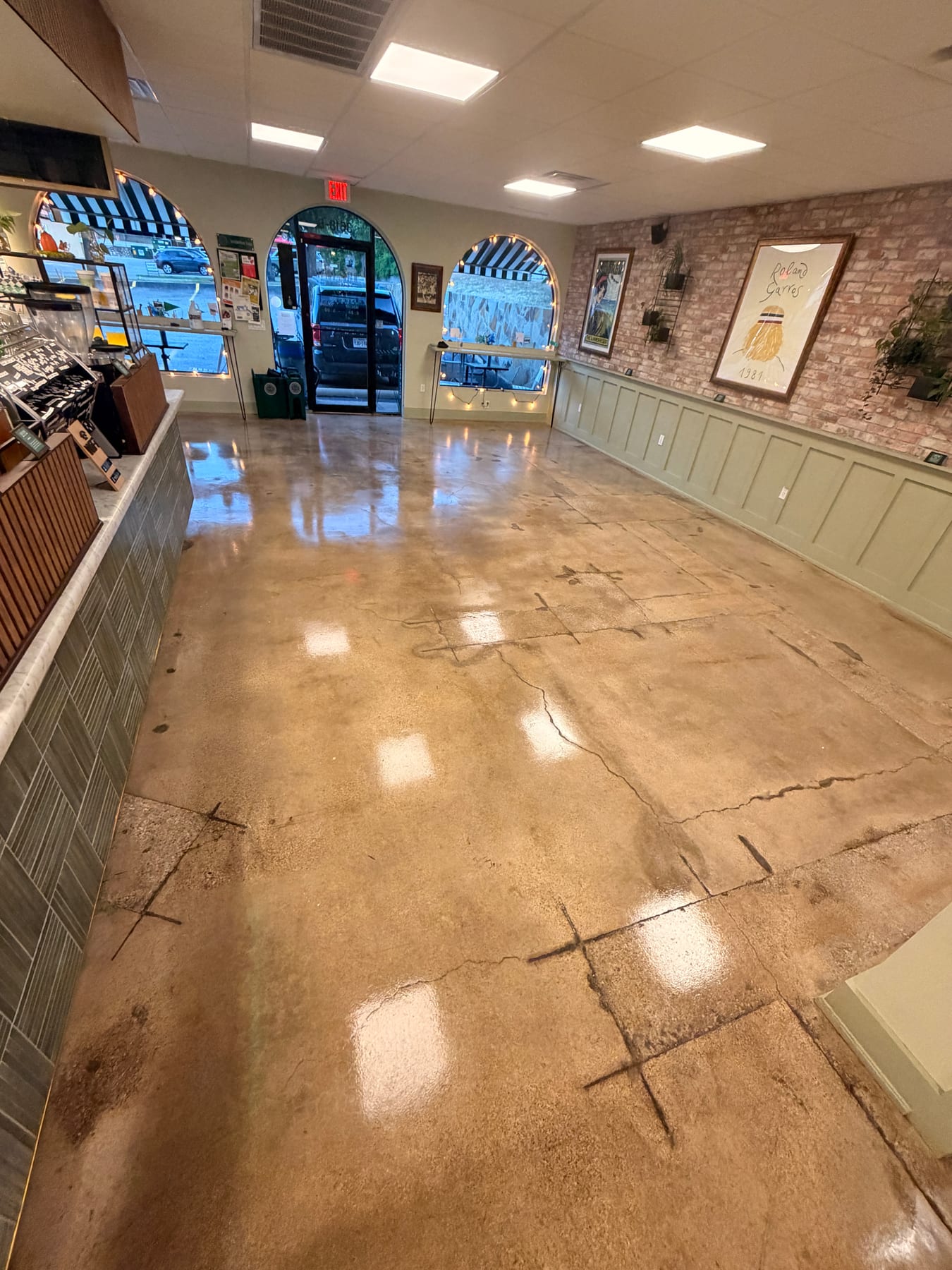
We don't grind or mechanically polish concrete. On concrete we scrub, strip, degrease and seal, and our guide to commercial concrete floor cleaning covers how that works. One of our jobs was a café's roughly 2,000 sq ft of dull concrete, which we stripped, degreased and resealed with no grinding. It came out glossy from the sealer and finish coat, not from a polishing machine.
When is floor scrubbing the right job instead of burnishing?
Scrubbing is the right job when the floor is dirty, not just dull. Burnishing restores shine to a clean finish, while scrubbing removes the soil that dulls it. We sell scrubbing as a recurring service and as prep before stripping, recoating or degreasing.
As a standalone recurring service, scrubbing keeps traffic lanes and grit-heavy areas clean between bigger jobs. It can sit alongside recurring janitorial service, with the schedule set for that facility.
As prep, scrubbing comes before a recoat, a strip or a degrease. A recoat goes over a scrubbed floor, a strip starts with a clean surface, and a degrease on concrete needs the loose grit gone first. Scrubbing is also the main hands-on step on concrete, since we don't burnish it. The café restoration was a strip, degrease and seal, not a burnish.
Why can't you burnish a dirty floor?
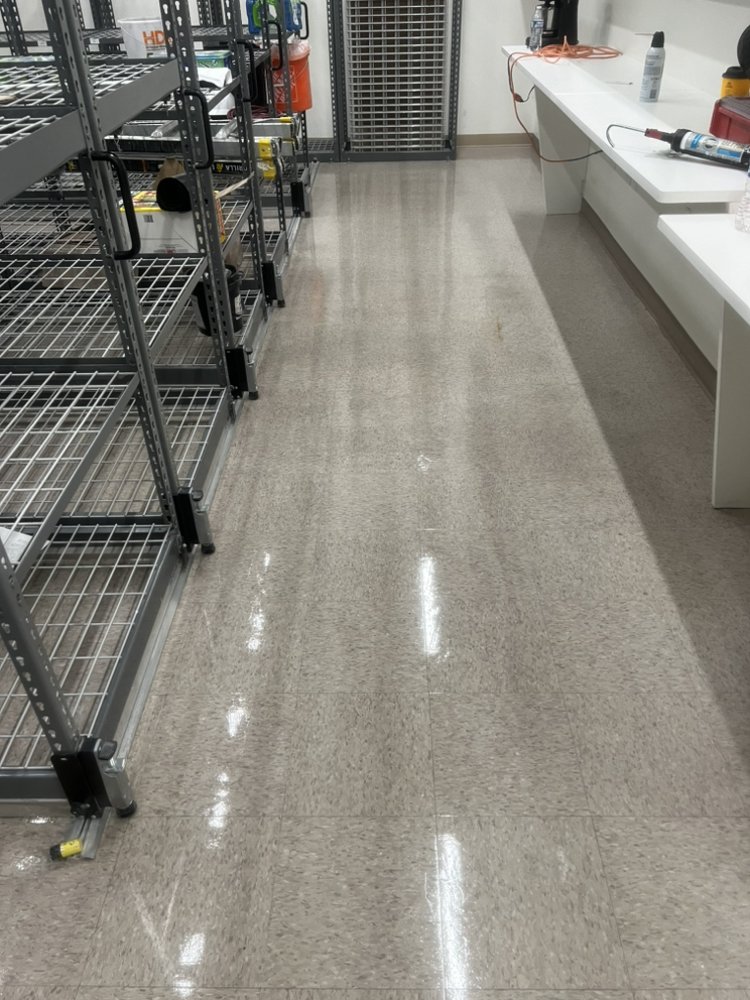
Burnishing a dirty floor presses the dirt into the finish. The high-speed pad heats the surface and traps whatever grit is sitting on it under the new shine. Nilfisk's guide warns to avoid burnishing a dirty floor because dirt can get trapped under the polish.
The order matters. Dust mop first, scrub or damp mop to remove soil, let the floor dry, and only then burnish. If the finish is yellowed, patchy or worn through in the traffic lanes, burnishing won't fix it. That floor needs a recoat or a strip, and our article on how often to strip and wax VCT explains how to tell which.
How do these jobs fit into one floor-care program?
A floor-care program layers the jobs: daily upkeep, regular burnishing, a recoat every 3 to 6 months and a full strip about once a year. Those intervals match what we see on real jobs, and traffic moves them.
- Daily: dust mop and damp mop or autoscrub to keep grit off the finish.
- Regular burnish: restores gloss between recoats. The interval depends on traffic.
- Scrub and recoat, every 3 to 6 months: deep-scrub the top layer, then add fresh coats.
- Strip, about once a year: remove all old finish and start over.
Published schedules land in the same place. One commercial hard-floor maintenance guide recommends scrubbing and recoating at least every 6 months, quarterly in high traffic, and stripping every 12 months.
On our jobs, the crew waits about 20 to 30 minutes between finish coats so each one can dry before the next goes on. The finish then needs several days to cure fully, and burnishing waits until it has cured. Follow the label on the finish you use.
Which floor types suit which service?
VCT and tile suit scrubbing, recoating and burnishing. Sealed concrete suits scrubbing, degreasing and resealing, but not burnishing from us. Which service a floor needs depends on whether it carries a finish.
| Floor | Scrub | Recoat or strip | Burnish (our service) |
|---|---|---|---|
| VCT | Yes | Yes | Yes |
| Tile | Yes | Where a finish is used | Yes |
| Sealed concrete | Yes | Strip, degrease and reseal | No |
| Bare concrete | Yes, with a brush | Seal after degreasing | No |
Concrete follows a different rhythm. Commercial concrete is deep-cleaned every 6 to 12 months and resealed every 3 to 5 years, as covered in our concrete floor article.
Who scrubs and burnishes commercial floors in Dallas–Fort Worth?
Texas Industrial Cleaning Services scrubs, strips and refinishes commercial floors, and burnishes VCT and tile, across Dallas, Tarrant, Denton and Collin counties. Our strip-and-wax jobs include classrooms, break rooms and storerooms. The two VCT photos on this page and the café photo are from our own jobs, and they show the finish, not the machine that produced the shine.
Every job starts with a free on-site walkthrough, where we look at the floor and set the plan. See our commercial floor care page for the full scope, or request a free walkthrough.
Charles Penn, owner-operator of Texas Industrial Cleaning Services, is OSHA 30-certified (General Industry).