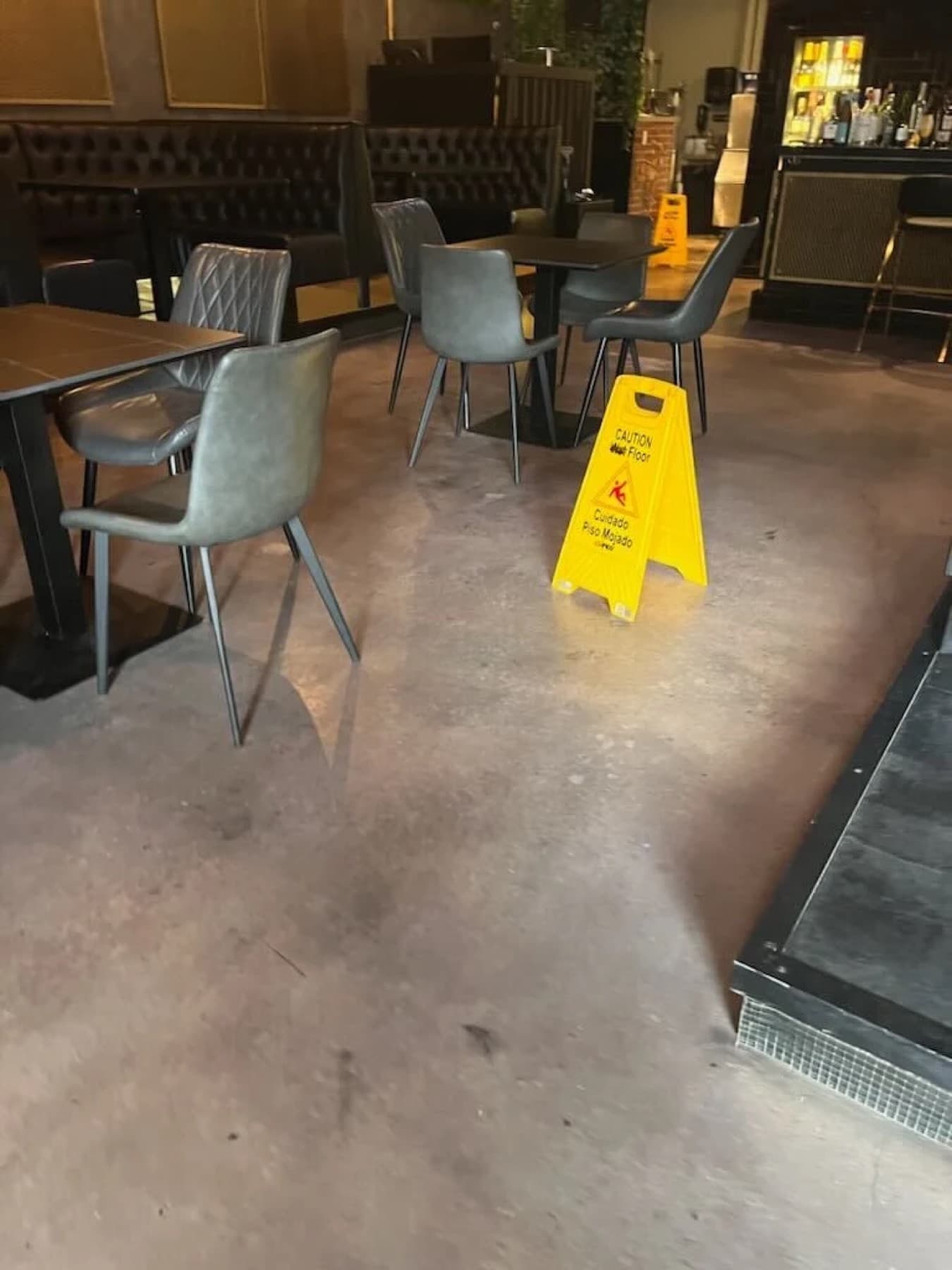
Commercial kitchen floor cleaning means degreasing the floor, not just mopping it. Kitchen floors are generally cleaned by sweeping, applying an alkaline degreaser for its label dwell time, scrubbing the tile and grout with a brush or pad, then extracting the dirty water so the grease leaves the floor instead of drying back into it.
Texas Industrial Cleaning Services is a commercial cleaning company serving the Dallas–Fort Worth Metroplex. We provide office cleaning, commercial floor cleaning (including stripping and waxing), and recurring janitorial services for offices, medical and dental practices, and multi-tenant buildings across Dallas, Tarrant, Denton and Collin counties. Kitchen floors and walls are part of our restaurant cleaning services.
How do you clean a commercial kitchen floor?
Sweep, apply an alkaline degreaser for its label dwell time, scrub with a brush or pad, extract the dirty water, and let the floor dry. Extracting instead of mopping is what removes the grease rather than spreading it.
This is how kitchen floors are generally cleaned:
- Sweep up debris and food scraps so grit isn't ground into the tile.
- Apply an alkaline degreaser and leave it for the dwell time on its label. Don't let it dry on the floor.
- Scrub with a stiff brush or pad. Brushes reach into grout lines and textured tile that a flat mop can't.
- Extract the dirty solution with a wet vacuum or autoscrubber, then rinse and extract again.
- Let the floor dry fully before foot traffic returns.
Heavy buildup rarely comes up in one pass. The first deep degrease on a neglected floor often needs a second scrub on the worst areas.
Why does grease make kitchen floors slippery?
Grease is an oily residue, and an oily floor is generally slick underfoot. It also tends to collect in grout and get tracked across the floor during service.
OSHA (the Occupational Safety and Health Administration) treats this as a workplace-safety issue. Its walking-working surfaces rule, 29 CFR 1910.22, requires that "the floor of each workroom is maintained in a clean and, to the extent feasible, in a dry condition," and that walking-working surfaces are kept free of hazards such as "leaks, spills." Where wet processes are used, the rule calls for drainage and, to the extent feasible, dry standing places such as platforms and mats.
How do you degrease quarry tile and grout?
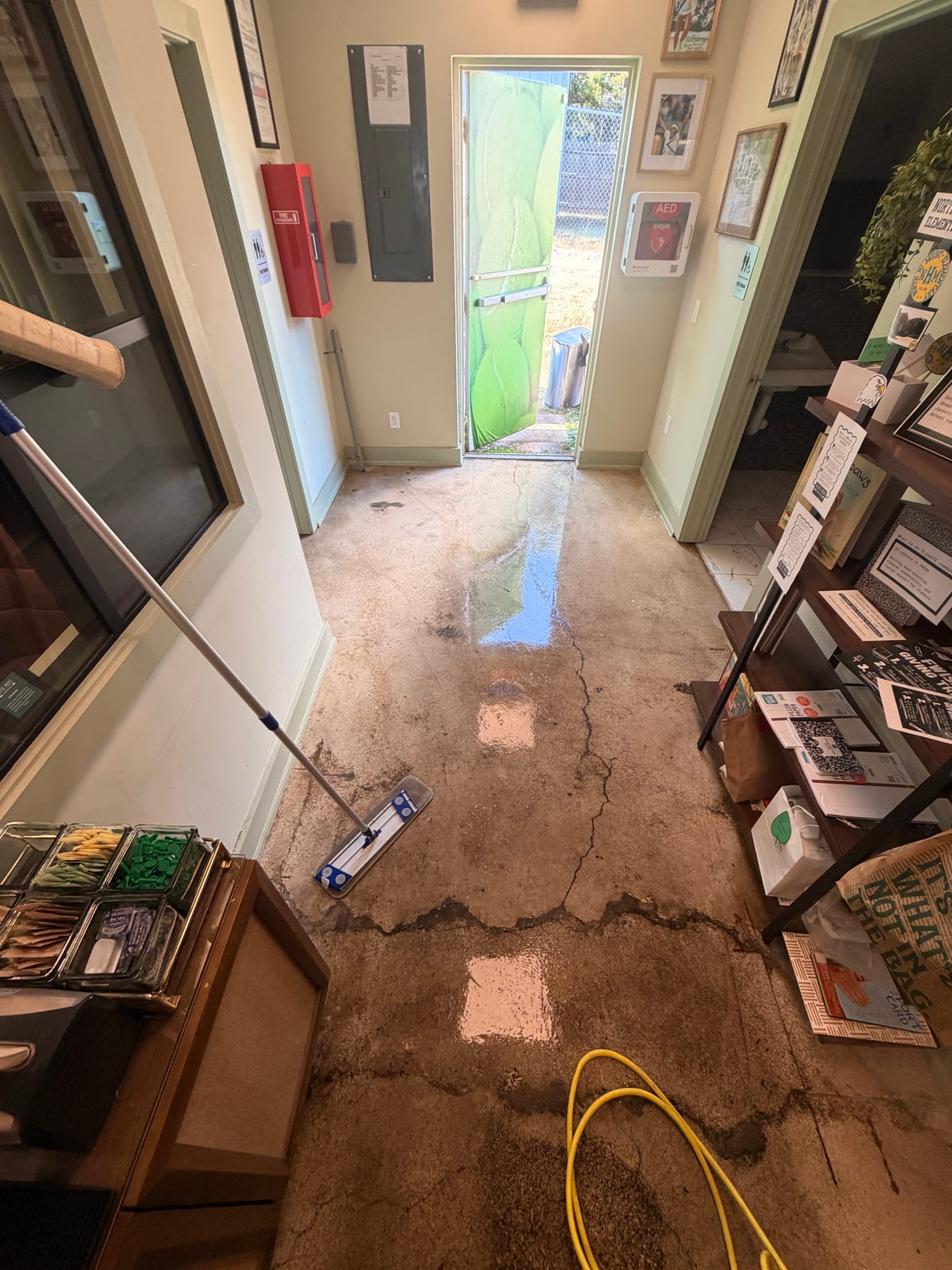
Quarry tile is degreased the same way as other kitchen tile, generally with more brush work. Grout is more porous than tile, so it tends to hold grease.
That is the problem with a mop, which mostly skims the top of the floor. A brush on a machine or a deck brush by hand generally works the degreaser into the grout line, and extraction pulls it back out. If you're searching how to clean quarry tile, that is the method: dwell, brush, extract, rinse.
Grout that has gone dark with grease may not come fully back. Grout sealing is available as an optional add-on after cleaning. Our commercial tile and grout cleaning covers kitchens along with restrooms, lobbies and break rooms.
Nightly clean vs. monthly deep degrease: what's the difference?
Our kitchen cadence is a nightly clean after close, Monday through Saturday, plus a deeper degrease about monthly. The nightly clean keeps grease from building up between deep degreases.
| Nightly clean | Deep degrease | |
|---|---|---|
| How often | Nightly, Monday through Saturday, after close | About monthly |
| Scope | Kitchen floors and walls, outside of equipment and the cook line | Kitchen floors and walls, outside of equipment and the cook line |
| Method, generally | Routine scrub and extraction | Longer dwell time and heavier scrubbing |
Recurring schedules are customized to each facility, and frequency can be changed mid-contract by updating the agreement. The walkthrough is where we set the schedule for your kitchen.
Why shouldn't a kitchen floor be burnished or polished?
Burnishing is a finish-care job, and a kitchen floor needs cleaning, not a shine. We burnish VCT (vinyl composition tile) and tile floors that carry a floor finish, and we never burnish concrete. Kitchen floors get scrubbing and degreasing.
If you want the full breakdown of buffing, burnishing and scrubbing, read buffing vs. burnishing.
How is sealed concrete in a kitchen different from tile?
Sealed concrete has no grout lines to hold grease, but it is a different job. Sealers wear with traffic, and worn concrete is generally more porous and more likely to absorb oil.
Concrete is degreased with an alkaline product, scrubbed, extracted and eventually resealed, typically every 3 to 5 years. Our guide to commercial concrete floor cleaning covers that cycle.
One of our own jobs shows the principle. A café's roughly 2,000 sq ft of dull concrete was stripped, degreased and resealed, with no grinding. A café is a food-service floor, but it isn't a commercial kitchen, and we won't pass it off as one. What carries over is the sequence: degrease before you seal, because a sealer over grease fails.
What does kitchen floor cleaning cover in Dallas–Fort Worth?
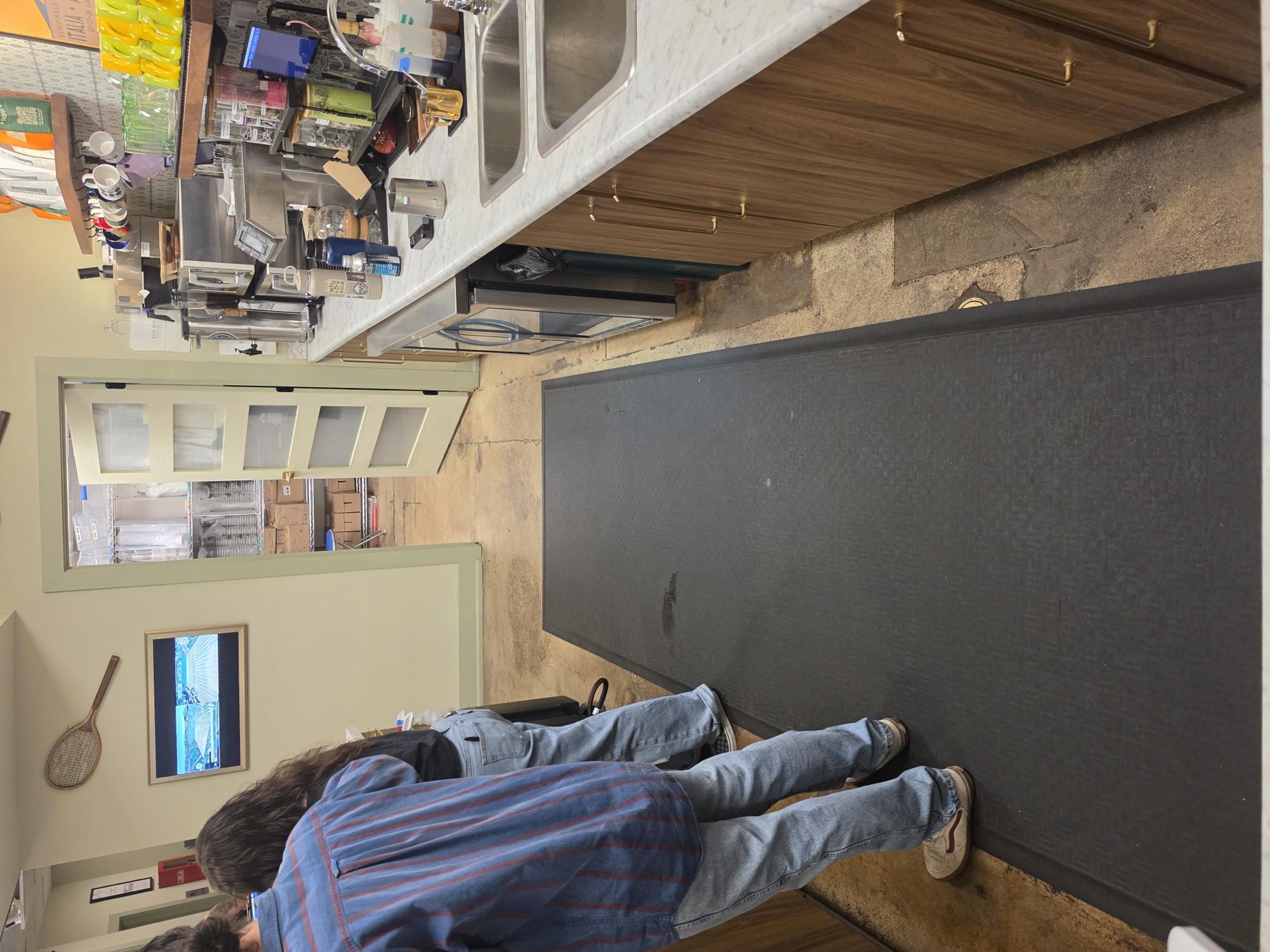
We degrease kitchen floors and walls, outside of equipment and the cook line, across Dallas, Tarrant, Denton and Collin counties. The work is nightly after close or as a one-time deep clean, and we can pair it with the dining room, bar and restrooms.
| We do | We don't |
|---|---|
| Kitchen floor degreasing | Hood and exhaust cleaning |
| Kitchen wall degreasing | Grease trap pumping |
| Tile and grout cleaning, with optional grout sealing | Floor drain cleaning |
| Dining room, bar and restroom cleaning | Floor mat cleaning |
| Nightly service Monday through Saturday | Equipment and cook line cleaning |
Hood and exhaust cleaning is its own specialist trade and needs its own contractor. Floor drains and floor mats are not in our scope.
We're fully insured, and a certificate of insurance is available on request. We're owner-operated and not a franchise. Every job starts with a free on-site walkthrough. For the full scope, see our restaurant cleaning services page, where you can request a walkthrough.
Charles Penn, owner-operator of Texas Industrial Cleaning Services, is OSHA 30-certified (General Industry).