Medical office cleaning covers exam and treatment rooms, waiting areas, reception, restrooms and staff areas, with disinfectants registered with the EPA (Environmental Protection Agency) left on patient-contact surfaces for the full contact time on the label. Dallas practices usually have it done after hours on clinic days, based on patient volume. It doesn't include regulated medical waste, sharps or sterilization.
Texas Industrial Cleaning Services is a commercial cleaning company serving the Dallas–Fort Worth Metroplex. We provide office cleaning, commercial floor cleaning (including stripping and waxing), and recurring janitorial services for offices, medical and dental practices, and multi-tenant buildings across Dallas, Tarrant, Denton and Collin counties.
This guide is written for the practice manager or office administrator who has to hire a cleaner, write the scope and answer for the waiting room when patients notice it. It covers medical and dental offices, not hospitals or surgical suites, which run their own environmental services programs.
What does medical office cleaning include?
A medical office scope splits into the rooms patients use and the rooms staff use. Patient rooms get disinfection on every visit; staff rooms get the same core cleaning as any office.
| Area | Every visit | On a rotation |
|---|---|---|
| Reception and waiting room | Disinfect chairs, armrests, counters, pens and clipboards, door handles; trash; floors | Reception glass, baseboards, vents, high dusting |
| Exam and treatment rooms | Disinfect the patient-contact surfaces on the written checklist, such as counters, sinks, chairs, light switches and door handles; trash; floors | Walls and ledges, cabinet fronts |
| Patient and staff restrooms | Clean and disinfect fixture by fixture, restock, trash, floors | Partitions, grout, vents |
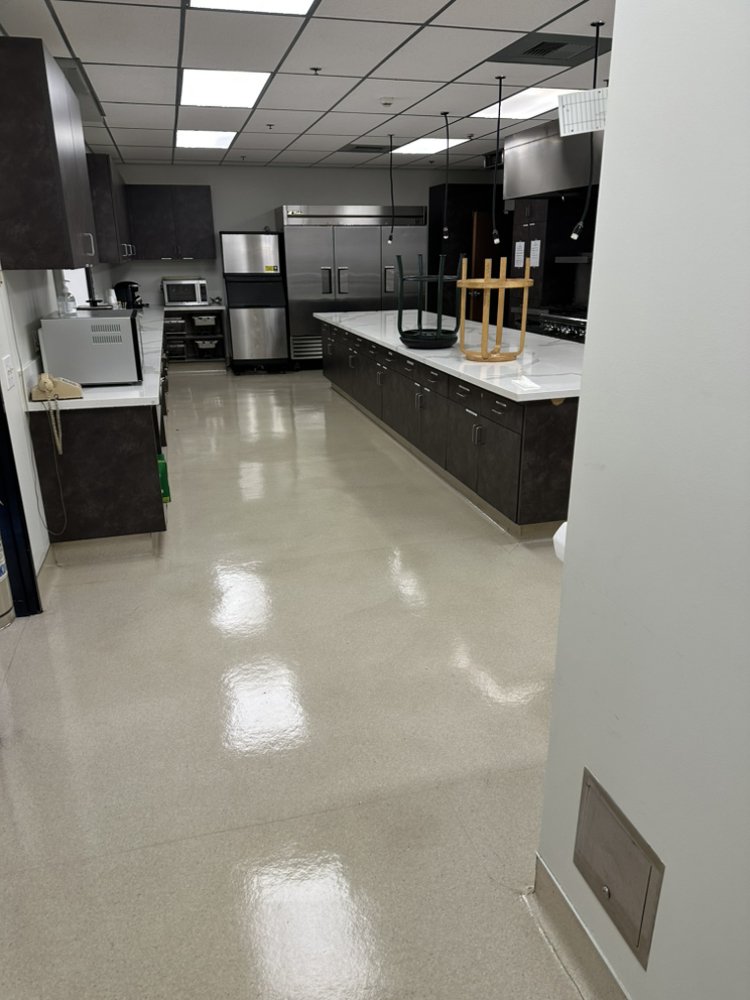
| Staff break room | Counters, sinks, tables, appliance handles, trash, floors | Inside the microwave and refrigerator fronts |
| Offices, billing and admin | Trash, touchpoints, carpet or hard floors in traffic lanes | Desk dusting, low-traffic carpet |
| Corridors and floors | Dust-mop and damp-mop or autoscrub hard floors; vacuum carpet | Burnishing; floor care on its own schedule |
On our medical work, exam and treatment rooms are cleaned to a written room-by-room checklist, and waiting rooms, reception glass and restrooms are detailed every visit. The checklist matters more here than in a regular office, because it spells out what gets disinfected in each room and what doesn't.
How is cleaning a medical office different from cleaning a regular office?
A medical office looks like a regular office, but the cleaning method isn't. A medical office is cleaned to stop germs moving from one surface to the next, and that changes how the crew works through the space.
These are the standard practices in medical and dental office cleaning:
- Dwell time, not wipe-and-move. An EPA-registered disinfectant only does what its label says if the surface stays wet for the full contact time. Spraying and wiping straight off is cleaning, not disinfecting.
- Color-coded microfiber. Cloths and mop heads are color-coded so the ones used in a restroom never touch an exam room, a counter or a desk.
- Clean to dirty, top to bottom. The crew works from the cleanest areas toward the dirtiest and from high surfaces down to the floor, so dirt isn't carried back over what's already done.
- Separate restroom equipment. Restroom tools stay in restrooms.
- Scheduled around patients. The work happens once the last patient has left, so nobody is cleaning around a waiting room full of people.
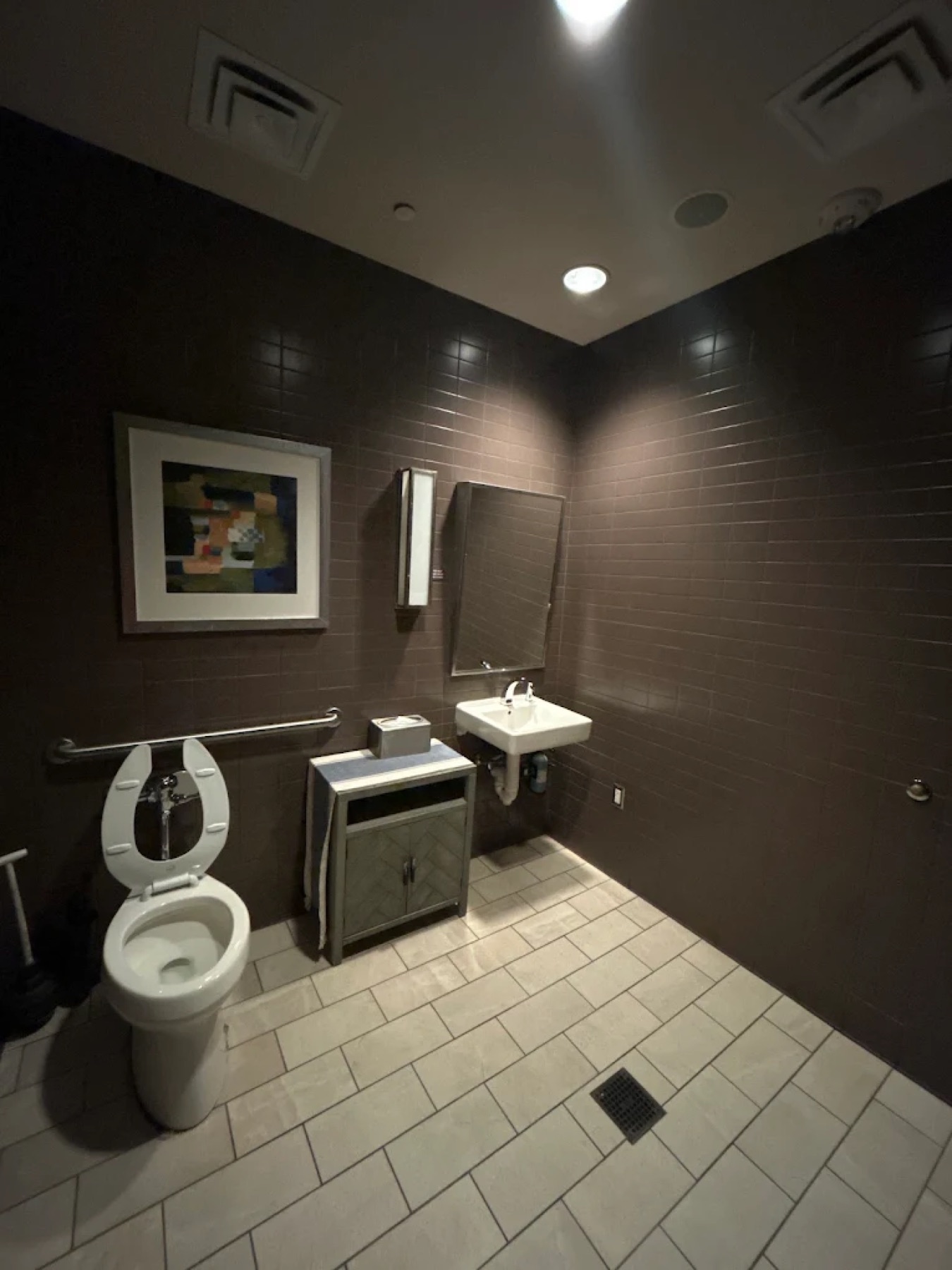
We clean patient-facing space with EPA-registered disinfectants, follow a documented dwell-time process, and treat every surface a patient touches as high-touch. That last part is the real difference: in an office, a door handle is a door handle; in a clinic, it's a surface every patient in the building touched today.
Where does the cleaning crew's job stop?
A cleaning crew cleans the space; your clinical team handles anything clinical. Writing that line down before the first visit prevents the 2 worst outcomes: something clinical gets touched, or something everyone assumed was covered gets skipped.
What a cleaning crew should not do:
- Regulated medical waste and sharps. These go to a licensed medical waste contractor. We are not a medical waste contractor and don't handle regulated waste or sharps containers.
- Sterilization. Instruments and sterilization equipment stay with your clinical staff.
- Charts and clinical work areas. Our crews are trained not to touch charts, equipment or anything in a clinical work area.
- Between-patient turnover. Wiping down an exam table or a dental chair between patients during the day is part of patient care, done by your team.
What the crew does is the cleaning around all of that, to a written scope. If a room has equipment nobody outside your team should touch, name it before the first visit so it's written into the scope as an exclusion.
How often should a medical or dental office be cleaned?
Most practices need cleaning after every clinic day. Exam rooms, patient restrooms and the waiting room take contact all day, and they're the rooms patients judge the practice by the next morning.
- Practices open 5 days a week: usually nightly, after the last patient.
- Practices with fewer clinic days: cleaning nights can follow clinic days, with a lighter pass on admin-only days.
- Saturday clinics: Saturday service is available; we don't clean on Sundays.
A regular office without patients can often run on fewer nights. One corporate office we've cleaned was done 3 nights a week, and every visit covers the full scope: restrooms, carpet, break rooms, windows and the lobby. A practice with patients in every weekday usually can't skip nights that way, because its exam rooms and patient restrooms take new contact every clinic day.
The schedule is set per practice and written into the scope, and split schedules are fine: restrooms and exam rooms on every clinic day, private offices less often. For how the trade-offs work in any building, here's how to choose between nightly, 3-night and weekly cleaning.
What about dental offices?
Dental offices follow the same method with a different floor plan: more treatment rooms (operatories) per square foot, a sterilization area, a lab in some practices, and a busy reception desk. Operatories get the same patient-contact disinfection as exam rooms.
The line between crew and clinical staff matters even more in dental, because so much of an operatory is equipment. The chair, delivery unit and instruments get disinfected between patients by your team; the after-hours crew cleans the floors, counters on the checklist, sinks, restrooms, reception and waiting room. Sterilization areas are usually either excluded or limited to the floor, and that gets agreed at the walkthrough.
Why do the floors matter so much in a medical suite?
Floors are the largest surface in the building and the first thing a patient sees when they walk down the hallway. Medical suites usually have VCT (vinyl composition tile) in corridors and exam rooms because it handles rolling equipment and daily disinfecting.
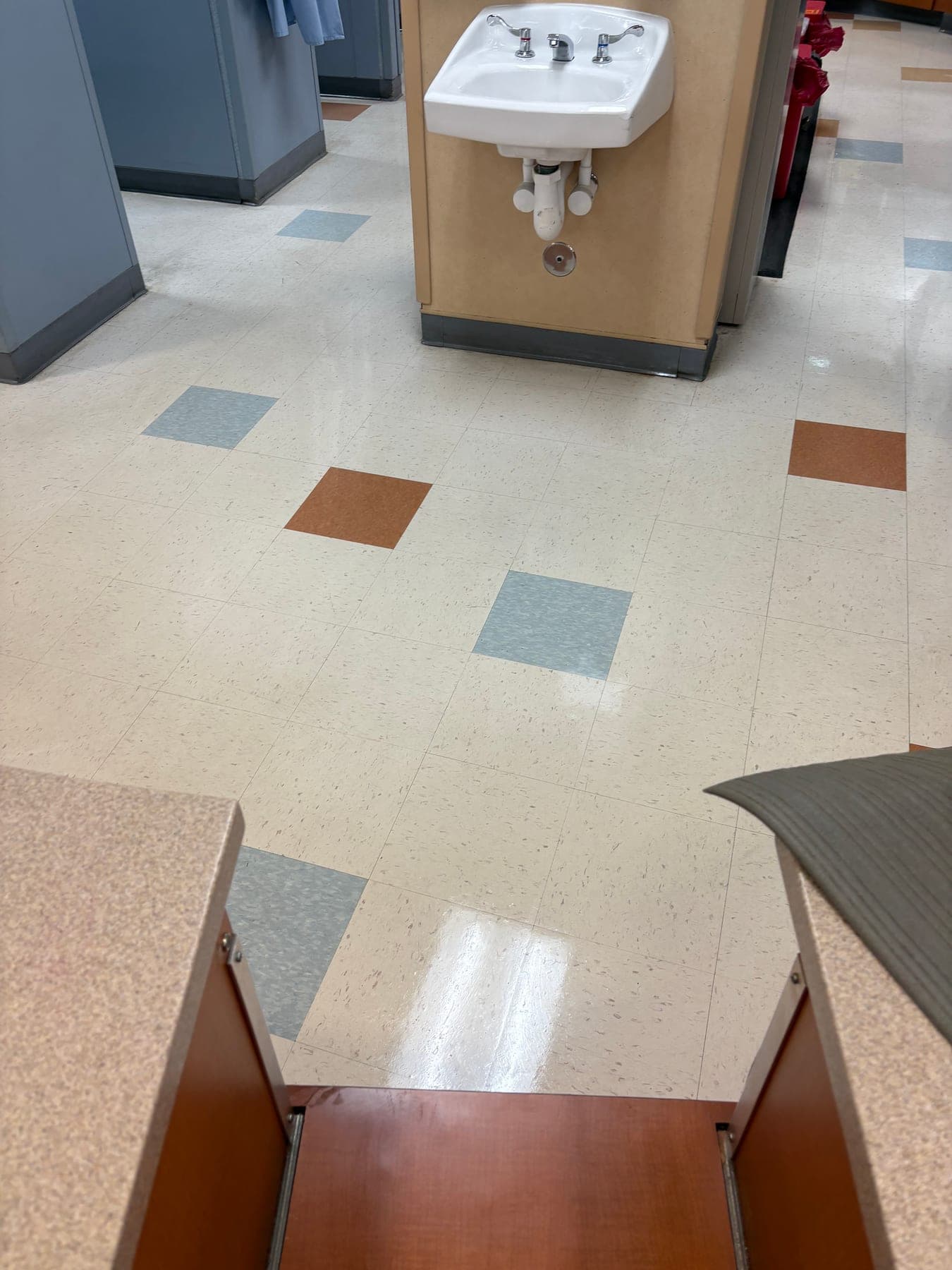
The corridor photo at the top of this article is from one of our own jobs, a medical suite where we refinished the VCT. The standard upkeep is a dust mop and damp mop (or an autoscrubber, a machine that scrubs and picks up the dirty water in one pass) on every visit, periodic burnishing, and a full strip and refinish on a longer cycle. Here's how often VCT needs a strip and wax.
Floor care belongs on its own line in the scope with its own date, because the area has to be closed while it's done. In a practice, that means after hours or on a Saturday, when no patients are booked.
What drives the cost of medical office cleaning?
Square footage, frequency, foot traffic and team size set most of the monthly cost, the same as any recurring work. A medical office adds 2 things on top: more rooms that need disinfection, and more restrooms per square foot.
- Exam and treatment room count. Each one is a set of patient-contact surfaces disinfected on every visit.
- Restroom count. Patient and staff restrooms are cleaned and disinfected fixture by fixture.
- Frequency. Every added night is another full pass through the patient rooms.
- Foot traffic. A busy family practice and a specialist seeing 10 patients a day in the same suite are different jobs.
- Floor care. Refinishing VCT is periodic work, priced as its own line.
We don't publish a price. Our recurring work is billed as a flat monthly rate, set from a free on-site walkthrough, and it's locked for the 12-month term.
How do you vet a medical office cleaning company in Dallas–Fort Worth?
Ask questions that only a medical cleaner can answer well. An office cleaner can say "yes, we disinfect"; these questions ask how.
- Which disinfectants, and how do you handle dwell time? Look for EPA-registered products and an answer about leaving surfaces wet for the label's contact time.
- How do you keep restroom tools out of exam rooms? Color coding or separate equipment, stated plainly.
- Is there a written room-by-room checklist? And will you see it?
- Who handles medical waste and sharps? The right answer is your licensed contractor, not the cleaner.
- What does the crew not touch? Charts, equipment and clinical work areas should be named.
- Is it the same crew every visit? We send the same crew every visit, so the people who learn your exam rooms keep cleaning them.
- How is after-hours access handled? Keys, codes and alarm procedures, followed the same way every visit.
- What happens when something's missed? If something in the agreed scope gets missed, we re-clean the affected area.
- Insurance and contract terms? We're fully insured, with a certificate of insurance on request. Our recurring agreements run 12 months with a 30-day no-cause exit and the rate locked for the term. Here's what a janitorial contract should include.
The owner-operator is OSHA (Occupational Safety and Health Administration) 30-certified, and every account starts with the same free walkthrough.
Medical office cleaning across Dallas–Fort Worth
We clean medical and dental offices across Dallas, Tarrant, Denton and Collin counties, from Dallas and Fort Worth to Arlington, Irving, Plano, Frisco and McKinney. The work happens after hours, once your last patient has left. Our office hours (daily, 9am to 5pm) are when you can reach us.
Medical and dental suites are part of our office cleaning in Dallas, where you can see the full scope. When you're ready, book a free walkthrough for your practice and we'll write the scope room by room.